Compare & Decide · 5 min read
Is Paint Protection Film (PPF) Worth It In 2026? Honest Guide
Real-world breakdown of paint protection film: what it costs, what it actually protects against, where it fails, and how to decide if PPF is right for your vehicle.
The Rabbit Wash Team · Published May 18, 2026 · Updated Sep 21, 2026
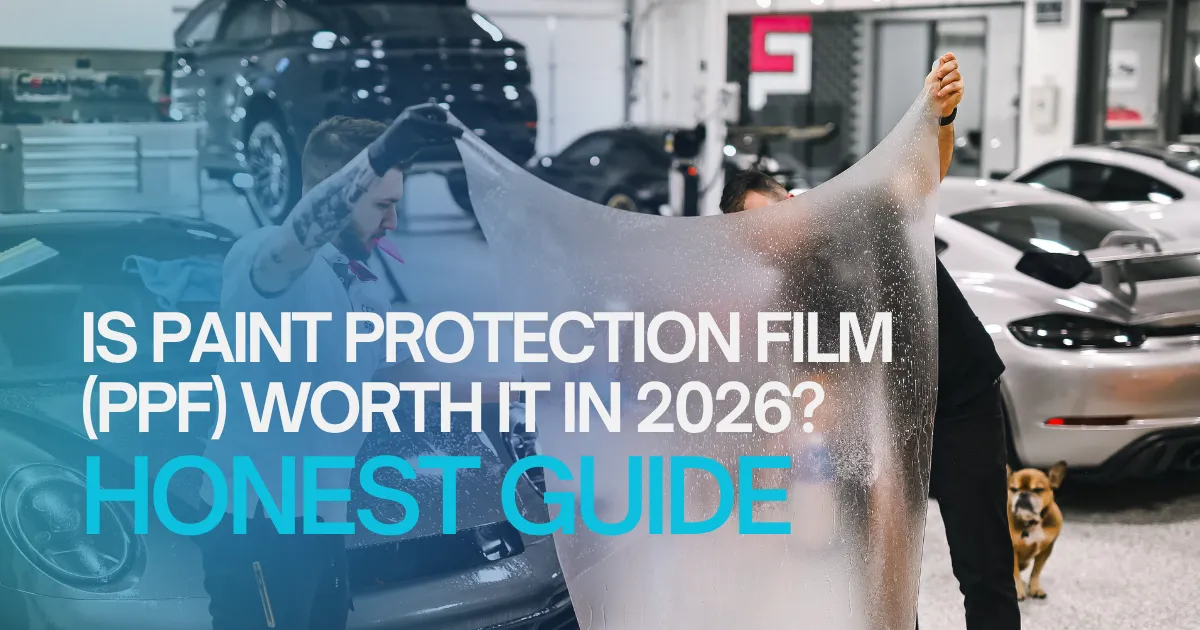
Paint protection film, or PPF, is the most expensive paint defense product on the market — and the most misunderstood. Done right, it can preserve a vehicle’s finish for the entire ownership period. Done wrong (or skipped), it leaves owners frustrated about damage that ceramic coating was never supposed to prevent.
This guide answers a common question: is PPF actually worth it, and if so, on which panels? We’ll cover what it costs, what it does that ceramic can’t, where it fails, and how to decide.
What PPF Actually Is
Paint protection film is a clear, self-healing polyurethane film that adheres to your vehicle’s painted surfaces. The film is typically 6–8 mils thick — about three times the thickness of a standard vinyl wrap — and is engineered to absorb impact.
Unlike ceramic coating, which is a thin chemical layer measured in microns, PPF is a physical barrier. When a rock hits a PPF-protected panel at 65 mph, the film deforms and self-heals; the paint underneath is untouched.
What PPF Protects Against
- Rock chips — the primary reason most owners buy PPF.
- Light scratches from car washes, brushes against bushes, etc. (self-heals in heat).
- Bug splatter and acidic bird droppings (PPF resists what bonds to clear coat).
- UV fading on protected panels.
- Minor parking-lot dings (the film distributes the impact slightly).
What PPF Does NOT Protect Against
- Deep door dings or panel damage.
- Vandalism (key scratches go through the film into paint).
- Hailstone damage at high impact.
- Improper care (yes, you still need to wash a PPF’d car correctly).
The Cost Picture
PPF is the most labor-intensive service in the detailing world. A proper installation involves:
- Full paint decontamination and prep.
- Custom-cut film templates (or hand-cut by an experienced installer).
- Surface application using slip solution and squeegees.
- Careful edge wrapping and trimming.
- Heat-setting to lock the film’s adhesive.
A careful install takes the best part of a working day, and that labor is reflected in pricing. The Rabbit Wash's paint protection film service includes surface prep and decontamination and custom film cutting and fit; its current price is on the packages page.
Partial Vs Full Coverage
Almost no one wraps the entire car. Most owners choose strategic coverage:
Front-End (Most Common)
Bumper, hood, front fenders, headlights, side mirrors — the surfaces that take most of the rock chips at freeway speeds. This is the most common choice for daily drivers.
"Track Pack"
Front-end + rocker panels + rear wheel arches. Built for cars driven hard on roads with debris, or for owners doing canyon runs.
Full Body
Every painted panel. Usually reserved for high-value cars and show cars, where any chip is expensive.
PPF And Ceramic Coating Together
The strongest paint defense in 2026 is PPF plus a ceramic coating layered on top of the film. The film handles impact; the ceramic makes the film hydrophobic and resistant to environmental staining (PPF can yellow slightly over time without a top coat).
If you want both, ask for them together: the film goes on first, then the coating. The Rabbit Wash offers both paint protection film and ceramic coating.
Who PPF Is Actually Worth It For
PPF is worth it if:
- The car is new or near-new (within 12 months).
- You’re keeping the vehicle 4+ years.
- It’s a darker color (rock chips show up worse on darker paint).
- You drive freeways daily or take canyon / highway road trips.
- You bought a model where paint repair is expensive (Tesla Model S/3/X/Y, Porsche, BMW M, AMG, Lucid, Rivian).
- You park outdoors on streets with construction or landscaping traffic.
Who Should Skip PPF
- Lease holders on 2–3 year terms (you’ll never recover the cost).
- Older daily drivers where paint repair costs little compared with the film.
- Cars stored mostly in garages and driven only on weekends.
- Owners planning to sell within 18 months.
For all four groups, ceramic coating alone gives the better cost-to-value ratio. Read our ceramic vs wax breakdown.
How Long Does PPF Last?
Quality film carries a manufacturer warranty of 7–10 years against yellowing, cracking, and de-lamination. Real-world service life in California sun is closer to 8–12 years before edges start to lift. The self-healing property remains active for at least the first 5 years.
Common Myths
"Ceramic Coating Does The Same Thing"
It doesn’t. Ceramic is chemical protection (microns thick). PPF is physical impact absorption (mils thick — about a thousand times thicker). They solve different problems.
"PPF Turns Yellow"
Cheap film from a decade ago did. Modern top-tier films (XPEL Ultimate Plus, SunTek Ultra, Stek DynoShield) use clearer urethane chemistry and resist yellowing for 8+ years.
"You Can Install PPF Yourself"
You can attempt to, the same way you can attempt to install your own brakes. Most DIY installs have visible edges, trapped air, and uneven trim within a year. Pro installation matters more than the brand of film.
The Verdict
PPF is worth it when three things line up: you’re keeping the car several years, the car holds its value, and you drive enough miles for rock-chip exposure to matter. For owners of newer, higher-value daily drivers, front-end coverage can pay for itself the first time it saves a bumper or hood from a repaint.
If you're deciding between film and coating, start with how long you'll keep the car and how you drive it. You can see paint protection film, compare it with ceramic coating or browse all packages.
Frequently Asked Questions
How much does paint protection film cost?
It depends on how much of the car you cover, the film and the vehicle. Front-end coverage costs far less than a full-body wrap. The Rabbit Wash's paint protection film service has a fixed price listed on its Packages page, with a surcharge for larger vehicles.
How long does PPF last on a car?
Quality paint protection film carries a manufacturer warranty of 7–10 years. Real-world service life in California is typically 8–12 years before edges start to lift.
Do you still need to wax a car with PPF?
No wax is needed. Most PPF installs are topped with a ceramic coating layer, which adds hydrophobicity and prevents film yellowing without the labor of repeated waxing.
Can you wash a PPF car normally?
Yes, but use a pH-neutral shampoo and the two-bucket hand-wash method. Avoid automatic brush washes — they create film edges that can lift over time.
Related Articles
Compare & Decide
How To Choose A Mobile Detailer In Los Angeles (7 Things To Check)
The best mobile detailer in Los Angeles is the one that is insured, uses paint-safe products, brings their own water, has clear pricing, and shows real before/after photos. Here are the seven things to verify before booking anyone.
May 24, 2026 · 5 min read
Compare & Decide
Is A Mobile Car Wash Worth It In Los Angeles? An Honest Answer
For many LA drivers, yes. You get the drive and the wait back, and a careful hand wash is kinder to paint than brushes. Here's an honest breakdown of when mobile wins and when a tunnel wash is fine.
May 24, 2026 · 5 min read
Compare & Decide
Mobile Vs Traditional Car Wash: Which Is Better For Your Car?
A careful mobile hand wash is kinder to paint, cleans the inside too and saves you the trip. A tunnel wash is faster and cheaper per visit. The honest comparison depends on your vehicle, your schedule and how much you care about long-term paint condition.
May 24, 2026 · 5 min read